FORCED CIRCULATIONFOOD CONCENTRATION SYSTEMS

Home / Selection

How to select a forced circulation evaporator

Compare forced-circulation proposals using a common evaporation duty, measured product properties, utility conditions and defined equipment scope.

Start with the net duty

State feed mass flow and inlet and target mass solids, or a measured water-removal requirement. Keep these values separate from circulation flow. Identify any upstream concentration or downstream processing boundary and use the same product basis across proposals.

Match equipment to the operating envelope

Review the most demanding product condition as well as normal operation. Connect pump selection, heater pressure loss, vessel inventory, vapour separation and concentrate discharge. Add quality limits and cleaning conditions before choosing an energy arrangement.

Ask for a proposal you can compare

Request the flow diagram, equipment boundary, material selection, utility schedule and acceptance method. Ask for identified photographs and drawings of the proposed equipment. Clarify installation, controls, cleaning connections and commercial responsibility in the offer.

Information to include in your enquiry

  • Measured feed and target solids
  • Final-product viscosity and particles
  • Steam, power and cooling service
  • Supply boundary and acceptance method
Equipment to review together

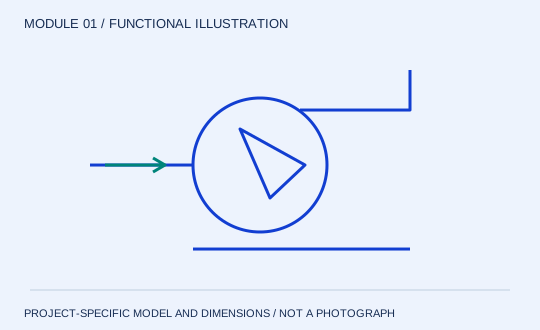
Circulation pump & drive functional diagram
MODULE 01

Circulation pump & drive

Keep the loop moving. The circulation pump sets the flow through the heater. That flow is distinct from the incoming feed and from the mass of water evaporated. Selection must follow the concentrated liquid throughout the planned operating range, including start-up and restart after cooling.

Review structure & specification →
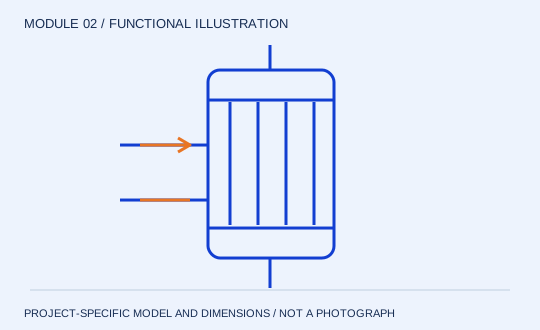
External heater functional diagram
MODULE 02

External heater

Add heat under pressure. In the common non-boiling heater arrangement, pressure in the circuit limits boiling within the heater. Heat is added before the liquid enters the flash zone. Tube or plate geometry is selected from product behaviour and pressure-drop constraints, rather than the circulation label alone.

Review structure & specification →
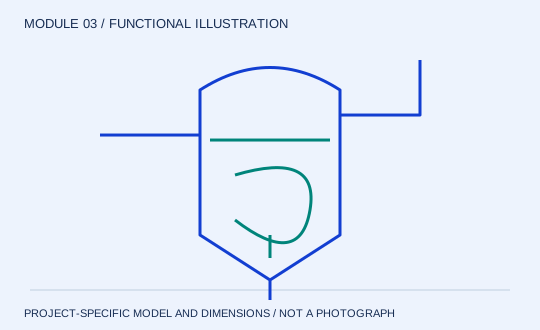
Flash separation vessel functional diagram
MODULE 03

Flash separation vessel

Release vapour and retain liquid. The pressure change at the separator enables part of the heated liquid to flash. The vessel provides space for vapour disengagement while maintaining liquid inventory for recirculation. Its level and geometry therefore affect both separation and pump suction.

Review structure & specification →