FORCED CIRCULATIONFOOD CONCENTRATION SYSTEMS

Home / Applications

Forced circulation evaporation of viscous food liquids

Assess viscous-liquid concentration using temperature-dependent rheology, loop pressure loss, suction conditions and repeated shear exposure.

Use a property curve, not one viscosity

State viscosity over the expected concentration and temperature range, with the measurement method and shear conditions. Include cold start or restart if relevant. A single room-temperature value cannot describe the complete circulation duty.

Check the hydraulic and heating duties together

Review how product viscosity changes loop pressure losses, suction conditions and heater flow. Distinguish circulation flow from feed capacity. Require a pump operating point and heater duty based on the same product properties.

Know when a finishing route needs review

If the concentrated product cannot meet acceptable pumping, heating or quality conditions, discuss the limiting evidence and alternative staging. Adding motor power alone does not resolve unsuitable passages, suction conditions or product shear.

Information to include in your enquiry

  • Viscosity versus concentration
  • Process and restart temperatures
  • Shear measurement conditions
  • Loop pressure-loss basis

Equipment to review together

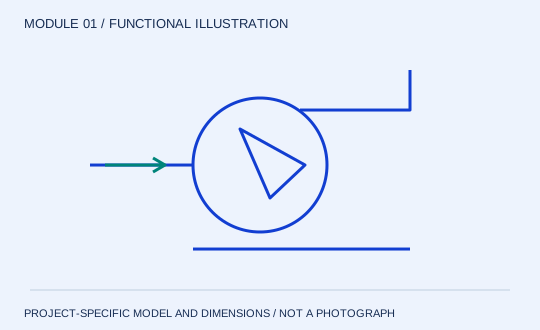
Circulation pump & drive functional diagram
MODULE 01

Circulation pump & drive

Keep the loop moving. The circulation pump sets the flow through the heater. That flow is distinct from the incoming feed and from the mass of water evaporated. Selection must follow the concentrated liquid throughout the planned operating range, including start-up and restart after cooling.

Review structure & specification →
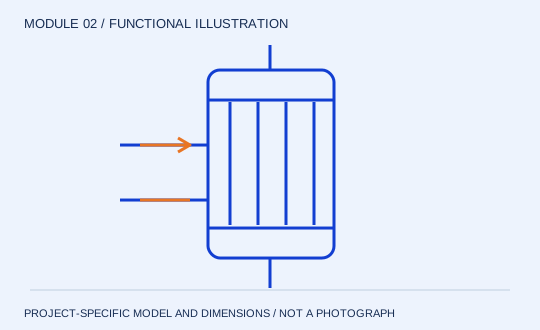
External heater functional diagram
MODULE 02

External heater

Add heat under pressure. In the common non-boiling heater arrangement, pressure in the circuit limits boiling within the heater. Heat is added before the liquid enters the flash zone. Tube or plate geometry is selected from product behaviour and pressure-drop constraints, rather than the circulation label alone.

Review structure & specification →
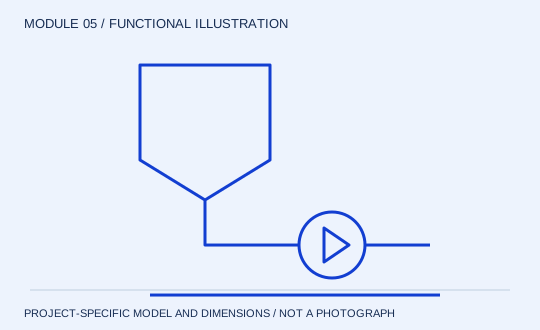
Concentrate discharge package functional diagram
MODULE 05

Concentrate discharge package

Control the product leaving the loop. Withdrawal and fresh feed must remain consistent with the water-removal duty and circulating inventory. The discharge equipment is selected for final concentrate properties, which may differ substantially from feed properties.

Review structure & specification →