FORCED CIRCULATIONFOOD CONCENTRATION SYSTEMS

Home / Material behaviour

High viscosity and fouling: define the limits

A difficult feed justifies investigation. It does not establish a universal equipment capability.

01

Measure at the concentrated end

Prepare viscosity data at several concentrations and temperatures, including the proposed final product. Record the measurement method and shear conditions. For a non-Newtonian liquid, one quoted viscosity without context cannot support pump or heater sizing.

02

Identify the deposit mechanism

Collect evidence of precipitation, crystallisation, product burn-on or other deposits. Record where they appear, how quickly duty declines and what cleaning removes them. These observations lead to different design questions; the word fouling alone is not enough.

03

Check the circulation trade-off

Increasing circulation changes pressure loss, shaft power and repeated shear exposure. A stronger flow is not automatically better for a food product. Request the proposed operating envelope and the product-quality evidence that supports it.

04

Plan for the limiting condition

Evaluate the most concentrated operating case, low feed, a utility interruption and restart after cooling. An acceptable hot steady-state trial does not prove that a cold loop can restart safely or without product damage.
Related equipment

Circulation pump & drive functional diagram
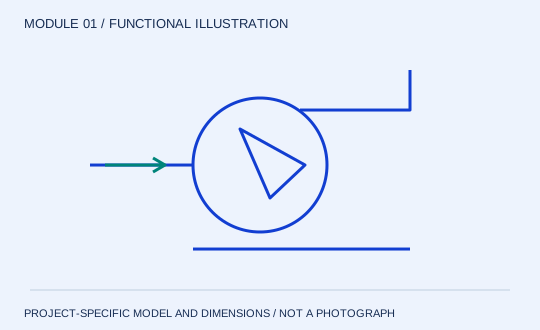
MODULE 01

Circulation pump & drive

Keep the loop moving. The circulation pump sets the flow through the heater. That flow is distinct from the incoming feed and from the mass of water evaporated. Selection must follow the concentrated liquid throughout the planned operating range, including start-up and restart after cooling.

Review structure & specification →
External heater functional diagram
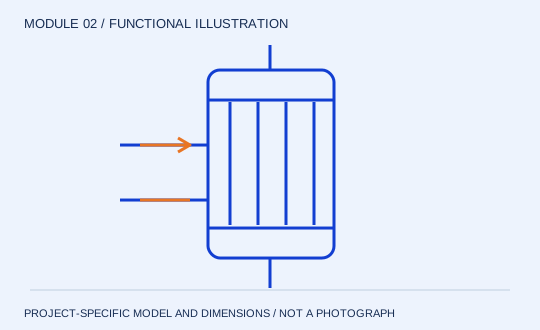
MODULE 02

External heater

Add heat under pressure. In the common non-boiling heater arrangement, pressure in the circuit limits boiling within the heater. Heat is added before the liquid enters the flash zone. Tube or plate geometry is selected from product behaviour and pressure-drop constraints, rather than the circulation label alone.

Review structure & specification →
Controls, sampling & CIP interfaces functional diagram
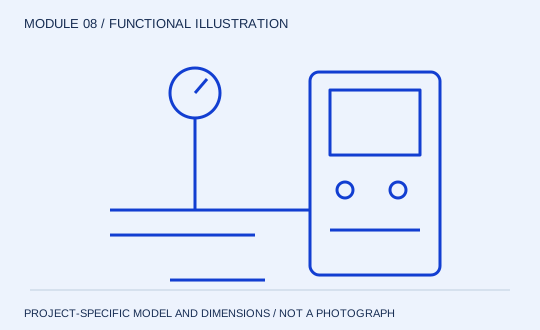
MODULE 08

Controls, sampling & CIP interfaces

Observe the limits; validate the clean. A useful control philosophy connects each process risk to a measurement and response. Loss of circulation, feed interruption or a changing vacuum needs a defined action. The cleaning boundary must include the pump and every product-contact part of the loop.

Review structure & specification →

Next step

Continue the engineering review →