FORCED CIRCULATIONFOOD CONCENTRATION SYSTEMS

Home / Quality

Thermal exposure and shear across repeated passes

Assess the complete history of the product, not only the nominal vessel temperature.

01

Map the product inventory

Count liquid in the vessel, heater, connecting pipes and any buffer. Explain how feed and withdrawal interact with that inventory. Repeated circulation means a simple heater transit time is not the complete residence history.

02

Use quality-sensitive measurements

Agree which product attributes should remain within limits, such as colour, texture or an identified composition measure. Compare representative samples before and after the actual proposed exposure. Do not infer preservation from vacuum operation alone.

03

Consider repeated mechanical exposure

The product passes through the pump and heater repeatedly. For shear-sensitive or particulate foods, evaluate texture, particle integrity and rheology with the process owner. A high circulation target is not a universal quality advantage.

04

Account for transient operation

Feed stops, slow discharge, warm holding and restarting can change exposure. Define the control response and disposition of off-spec material. Include these conditions when planning trials and commissioning.
Related equipment

Circulation pump & drive functional diagram
MODULE 01

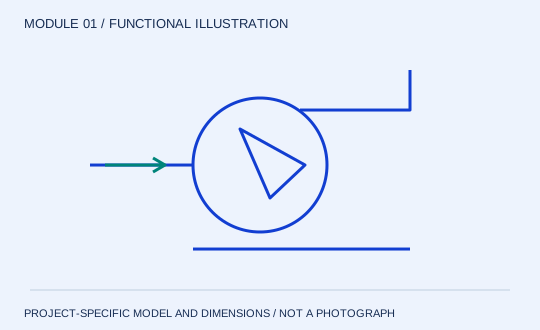
Circulation pump & drive

Keep the loop moving. The circulation pump sets the flow through the heater. That flow is distinct from the incoming feed and from the mass of water evaporated. Selection must follow the concentrated liquid throughout the planned operating range, including start-up and restart after cooling.

Review structure & specification →
Flash separation vessel functional diagram
MODULE 03

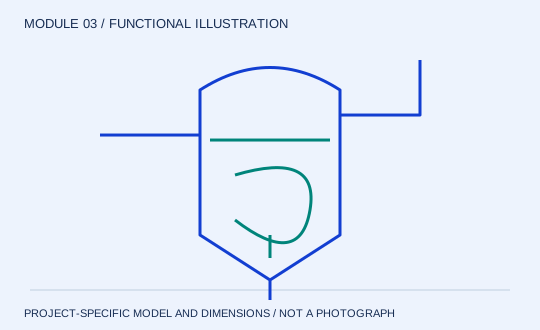
Flash separation vessel

Release vapour and retain liquid. The pressure change at the separator enables part of the heated liquid to flash. The vessel provides space for vapour disengagement while maintaining liquid inventory for recirculation. Its level and geometry therefore affect both separation and pump suction.

Review structure & specification →
Controls, sampling & CIP interfaces functional diagram
MODULE 08

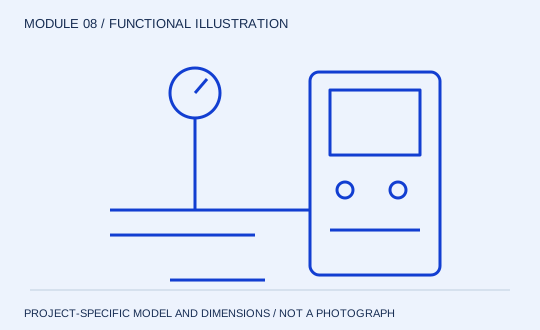
Controls, sampling & CIP interfaces

Observe the limits; validate the clean. A useful control philosophy connects each process risk to a measurement and response. Loss of circulation, feed interruption or a changing vacuum needs a defined action. The cleaning boundary must include the pump and every product-contact part of the loop.

Review structure & specification →

Next step

Continue the engineering review →