FORCED CIRCULATIONFOOD CONCENTRATION SYSTEMS

Home / Material behaviour

Particles, fibres and crystallising food liquids

Distinguish suspended solids from solids formed during concentration, and evaluate each mechanism.

01

Characterise what enters

Report particle-size distribution, fibre length, solids loading and any abrasive fraction. Explain whether the product must retain particle integrity or whether breakup is acceptable. This information influences pump, passages, valves and sampling.

02

Characterise what may form

Where precipitation or crystallisation is possible, provide solubility information and observations across temperature and concentration. Identify whether solids remain suspended, settle during a stop or grow on surfaces. Do not assume a pump prevents all deposition.

03

Review passage and wear together

A generous passage can reduce blockage risk but does not establish acceptable pressure drop or product shear. Ask how pump internals, heater channels and separator return geometry are matched to the same solids description.

04

Keep food and non-food scopes separate

Industrial crystalliser examples are evidence of a general process arrangement, not proof of food-contact suitability. Confirm material selection, cleanability and the actual product-specific operating envelope for the proposed food duty.
Related equipment

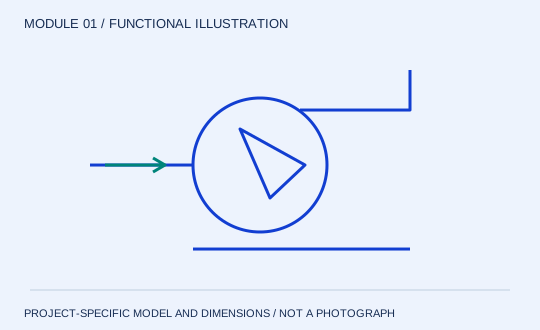
Circulation pump & drive functional diagram
MODULE 01

Circulation pump & drive

Keep the loop moving. The circulation pump sets the flow through the heater. That flow is distinct from the incoming feed and from the mass of water evaporated. Selection must follow the concentrated liquid throughout the planned operating range, including start-up and restart after cooling.

Review structure & specification →
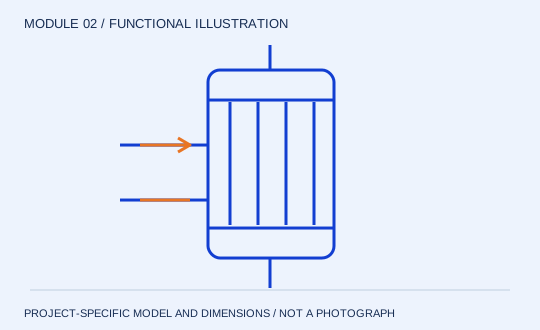
External heater functional diagram
MODULE 02

External heater

Add heat under pressure. In the common non-boiling heater arrangement, pressure in the circuit limits boiling within the heater. Heat is added before the liquid enters the flash zone. Tube or plate geometry is selected from product behaviour and pressure-drop constraints, rather than the circulation label alone.

Review structure & specification →
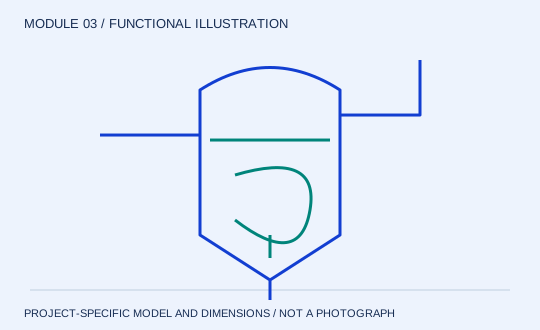
Flash separation vessel functional diagram
MODULE 03

Flash separation vessel

Release vapour and retain liquid. The pressure change at the separator enables part of the heated liquid to flash. The vessel provides space for vapour disengagement while maintaining liquid inventory for recirculation. Its level and geometry therefore affect both separation and pump suction.

Review structure & specification →

Next step

Continue the engineering review →